Definition

Big Small Prediction — What the Word Actually Means Here

Play Big Small

In every other context prediction implies information: a forecast built from something knowable. In this one it describes a guess between two options, made before the thing being guessed exists. That difference is not pedantry — it is the entire reason no tool in this category can work, and it is worth establishing before reading anything else on this site.

Sequence

Where the Result Comes From

Four stages in a fixed order. The third one is where every prediction claim quietly fails.

01

The timer runs

A round opens on a shared clock — commonly one, three or five minutes — and every connected player sees the same countdown.

02

Bets lock

Betting closes a few seconds before settlement. From this point your position cannot be changed, cancelled or hedged.

03

The digit is generated

After the lock, on the operator's infrastructure. This is the moment a prediction tool would need to have known something, and the value does not exist before it.

04

Settlement

Big or small is decided by which half the digit falls in, winning bets are credited, and the next countdown starts immediately.

Register

What "Prediction" Is Sold As

Four framings, each with a status and a ruling. The rest of this site works through them one category at a time.

Impossible

"The tool knows the next result"

Knowledge requires the value to exist. It does not exist until after your bet is locked, on hardware the tool cannot reach. This is not a question of accuracy or model quality — there is nothing to be accurate about.

Impossible

"Past rounds reveal the pattern"

Rounds are generated independently, so the sequence carries no information about the next one. A record of a thousand results tells you what a coin flip looks like and nothing else.

Partly true

"Our calls are right half the time"

They are, and so is alternating sides mechanically. Half is the ceiling for any two-outcome call, which is why a 50 percent hit rate is the least impressive statistic in this industry despite being the one most often quoted.

True

"You can improve your result"

By reducing turnover and session length — smaller stakes, slower rounds, a decided stopping point. This does not beat the operator's edge; it limits how much of your money the edge is applied to, which is the only genuine lever available.

Figures

The Numbers Behind the Whole Category

Five values that make every claim on this site checkable.

Outcomes in an even-money call2
Digits covered by each side5 of 10
Maximum achievable accuracy~50%
Typical payout on a win1.95x
Operator's share of turnover~5%

A 50 percent tool still loses money

Even a tool that genuinely hit half its calls would lose steadily, because a correct call returns less than double. Accuracy is not the variable that decides outcomes here — the payout is, and no software touches it.

Vocabulary

Words That Do Work They Have Not Earned

Four terms borrowed from fields where they mean something specific.

"Prediction"Implies information — supplies a guess
"AI" or "machine learning"Implies a learned pattern — none exists to learn
"Trend" and "signal"Implies momentum — rounds are independent
"Accuracy 100%"Implies a record — no tool publishes one
Side by side

What a Tool Shows You, and What Settles the Round

Two screens, one of which decides your balance.

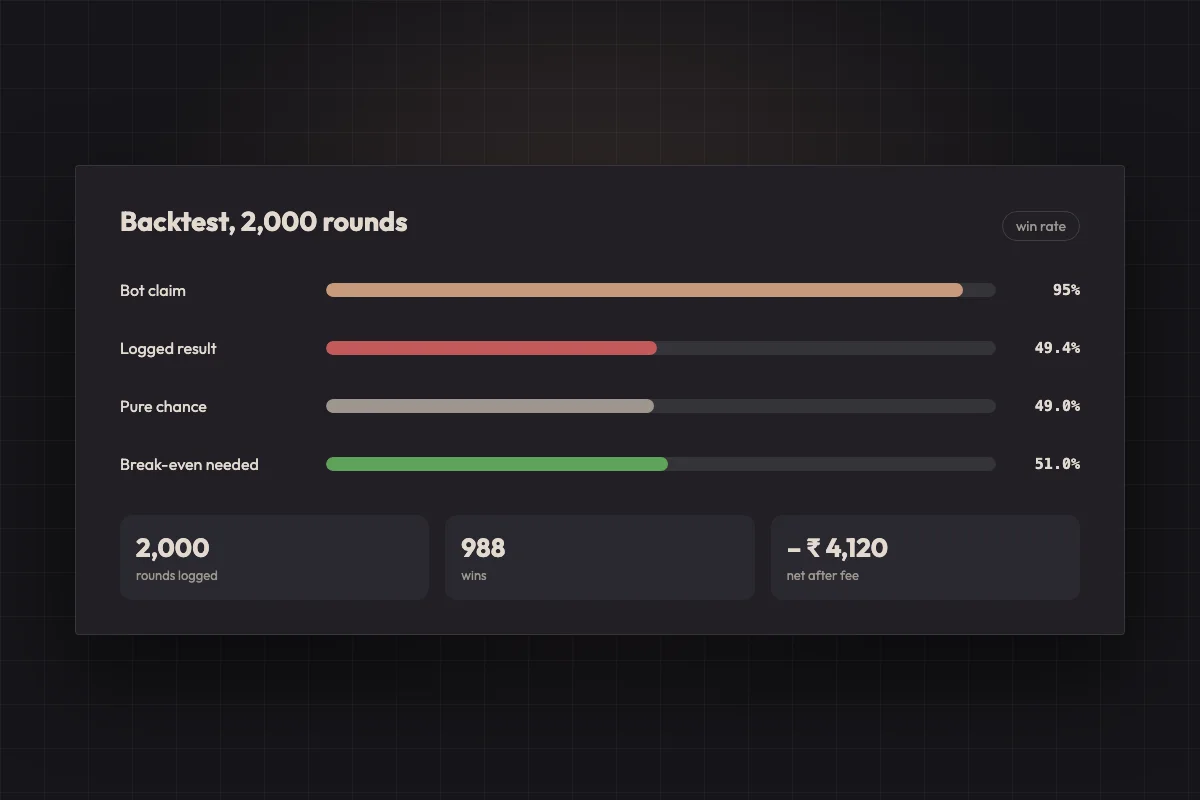
Backtest panel comparing a bot’s claimed ninety-five per cent win rate with the forty-nine per cent logged over two thousand rounds
The toolDisplays a call within a second of being asked, with no connection to the round it refers to.
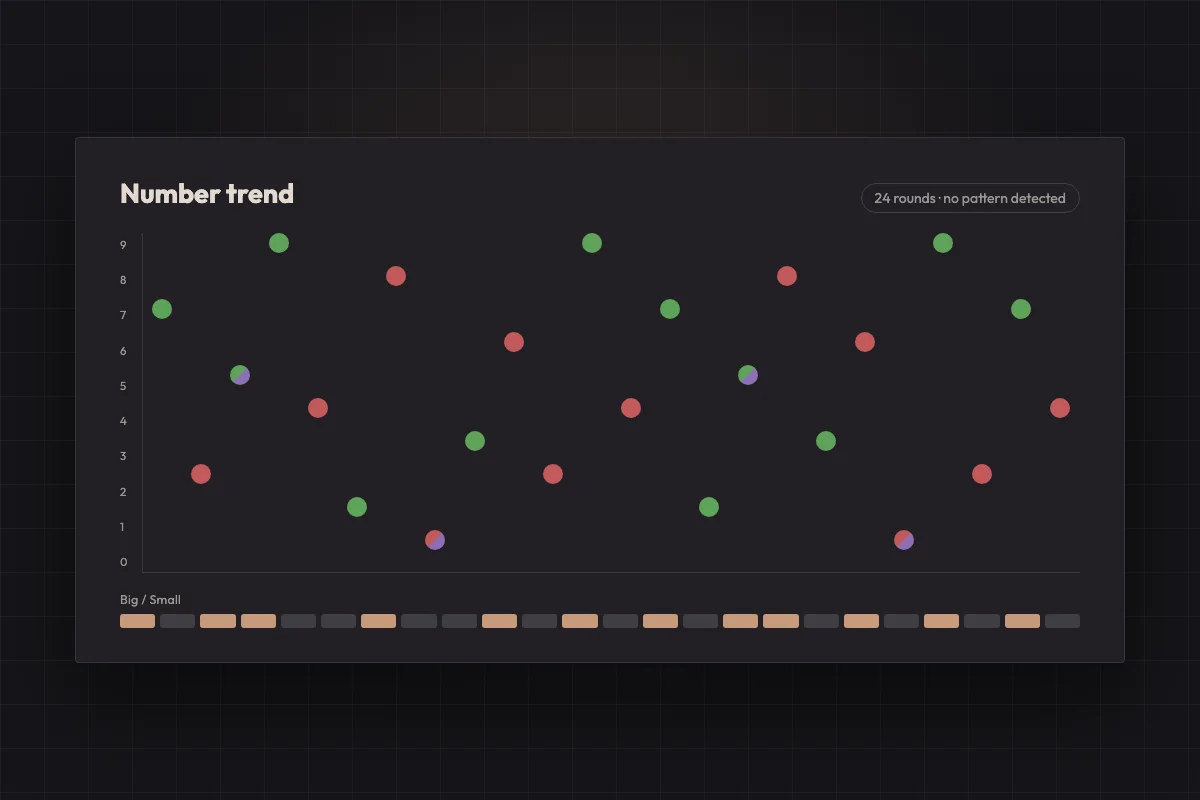
Number trend chart plotting the drawn digit across twenty-four consecutive rounds with no repeating pattern
The roundSettles from a digit produced after betting closes, on infrastructure neither you nor the tool can reach.

Why This Definition Comes First

Almost every page written about this subject starts from the tools and works backwards, which makes each product look like an open question. Starting from the round closes all of them at once. Once you can see that the value is produced after the bet is locked, the difference between a free web tool, a paid AI bot and a telegram group stops being a question of quality and becomes a question of price.

It also explains why this industry is larger than the game it attaches to. Selling a guess costs nothing to produce, needs no payment infrastructure and can be sold repeatedly to an audience that renews itself after every losing session.

What Would Change This Page

A tool that beat mechanical alternation over a large logged sample, with the log published. That would be the most interesting page on this site rather than the most inconvenient one, and the test is deliberately cheap to run: a hundred calls written down before each round, against a hundred calls made by flipping between sides. Nobody selling these products publishes such a comparison, and the reason is not shyness.

For the category-by-category breakdown, start with the hack claims register. For the arithmetic of what a session costs regardless of any tool, see the home page.

FAQ

Definition FAQ

Five questions about what prediction can and cannot mean in this context. Tap a card to turn it over.

01

Is any prediction possible at all?

Short answer

Not of the result. You can predict that roughly half of any long run of calls will be correct, which is true and useless. The specific digit is produced after your bet locks and cannot be known before it exists.

02

Why do tools show a hit rate then?

On statistics

Because half of any two-sided call is correct by arithmetic. A tool showing 50 percent is showing you the performance of a coin, and a tool showing 90 percent is showing you a number it typed itself.

03

Could an operator's system be predictable?

On generators

In principle a badly built generator could have weaknesses. In practice exploiting one requires access to outputs at scale and to the system itself — not a phone app sold for a monthly fee, and certainly not a web page with a button.

04

What about the 30-second rounds?

On speed

Faster rounds change nothing about predictability and a great deal about cost. Shorter timers multiply how many times per hour the operator's edge is applied, which is the only effect speed has.

05

So why does the industry exist?

On economics

Because a guess costs nothing to produce and sells to somebody who has already decided to play. The audience renews itself after every losing session, and no product in this category is ever required to publish a record.

06

Is the game itself dishonest?

On the operator

It does not need to be. Paying 1.95 on an even-money bet earns a steady percentage of everything staked with no interference in any round. The dishonesty in this category lives around the game rather than inside it.

This website is for informational purposes only and is not a gambling operator: we do not accept bets or payments. 18+. Gambling involves risk and may lead to addiction — please gamble responsibly. Information (bonuses/terms/licenses) may change: check current rules on the operator’s website. We are not responsible for decisions and financial losses related to the use of third-party services.